Kisspeptin after repeated exposure
The experiment becomes more interesting when the next response is smaller.
The first day and day 14
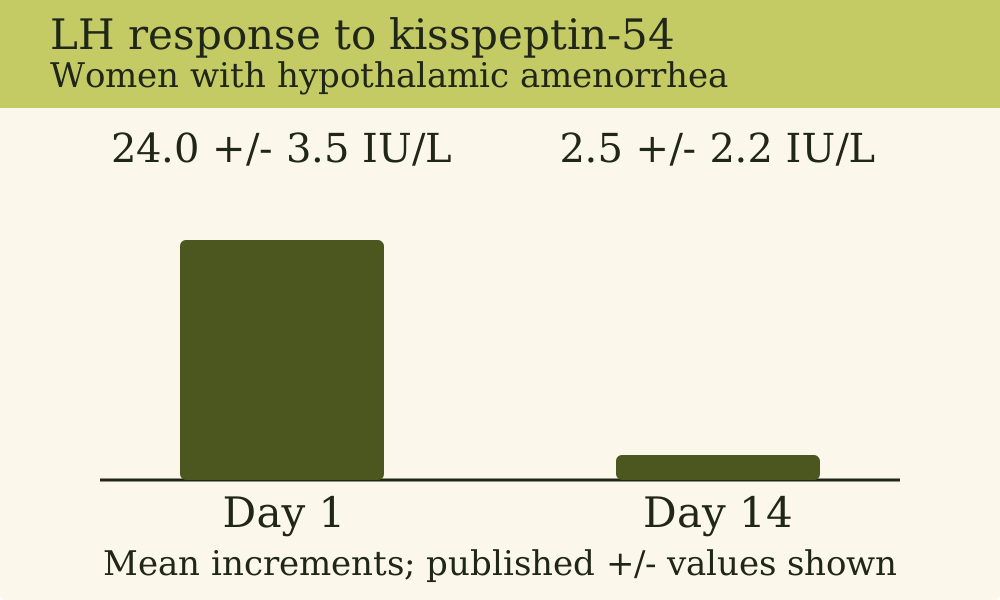
The 2009 study in women with hypothalamic amenorrhea contains a result that makes a simple more-is-better story difficult to sustain. On day 1, subcutaneous kisspeptin-54 produced a mean LH increment of 24.0 +/- 3.5 IU/L within 4 h. After repeated administration, the day-14 response was 2.5 +/- 2.2 IU/L. The authors described tachyphylaxis: a response that fades with repeated exposure.
The visual difference is striking, but its scope deserves equal prominence. These were women with hypothalamic amenorrhea, and the measurement was the LH increment. Converting those values into a prediction for testosterone in men would add an experiment that the paper never performed.
The result is valuable precisely because it complicates the attractive opening observation. A first response can be large while a later response under repeated exposure is much smaller. That gives duration a problem of its own, with its own measurements and a need to investigate the conditions that produced the change.
Continuous infusion
Another experiment in women with hypothalamic amenorrhea examined continuous intravenous kisspeptin-54. In the group of five women, LH pulses increased from 1.6 to 5.0 per 8 h versus vehicle. Pulse secretory mass also increased. At the highest infusion rate, however, the response weakened during the infusion.
There is an appealing restoration result here, alongside a limit encountered while the experiment was still running. I resist choosing whichever half makes the cleaner argument. The restoration shows that the reproductive signal could be driven in this group; the fading response at the highest rate shows why persistence needs to be measured rather than assumed.
The study also discourages an easy substitution of one population for another. The question under investigation involved a particular cause of disrupted reproductive signalling in women. A testosterone discussion can learn from that experiment's challenge to simple assumptions while still leaving its numerical findings with the participants who generated them.
Receptor sensitivity
The review of KISS1R pharmacology offers an explanation for the instability of the response. It describes receptor desensitization, internalization and recycling: receiving machinery can become less responsive, move inside the cell and return in a resensitized state. The balance helps govern how sustained or attenuated kisspeptin signalling becomes.
That is a more interesting biological picture than a switch left permanently on. Exposure history had played too small a role in my expectations. The receptor account gives a reason to take that history seriously, without pretending to identify a usable regimen from a review.
The receiving machinery participates in the response. That is the useful implication for me: an exposure history needs to stay attached to the result it helped produce. The first-day and day-14 observations make that implication visible in the human experiment, without establishing a universal timetable for other populations.
Intranasal delivery
The 2025 intranasal kisspeptin-54 study reported rapid LH stimulation in healthy men, healthy women and women with hypothalamic amenorrhea. No adverse events were reported in that study. The nasal-spray formulation was reported stable for up to 60 days at 4 degrees C. Those are separate findings about delivery, observed response and formulation stability.
The stability observation is easy to misplace. It describes the preparation under those storage conditions. The clinical observation concerns LH stimulation in the studied participants. Neither number can settle how long a useful response would persist with repeated exposure; that question needs its own experiment.
I welcome the ingenuity of investigating another route. It adds a concrete possibility to the research without erasing the receptor problem. The systematic review of clinical status surveys a range of reproductive applications, which makes this separation of questions especially useful. Progress in delivery can be real while work on persistence remains consequential.